
 +91 - 9266545422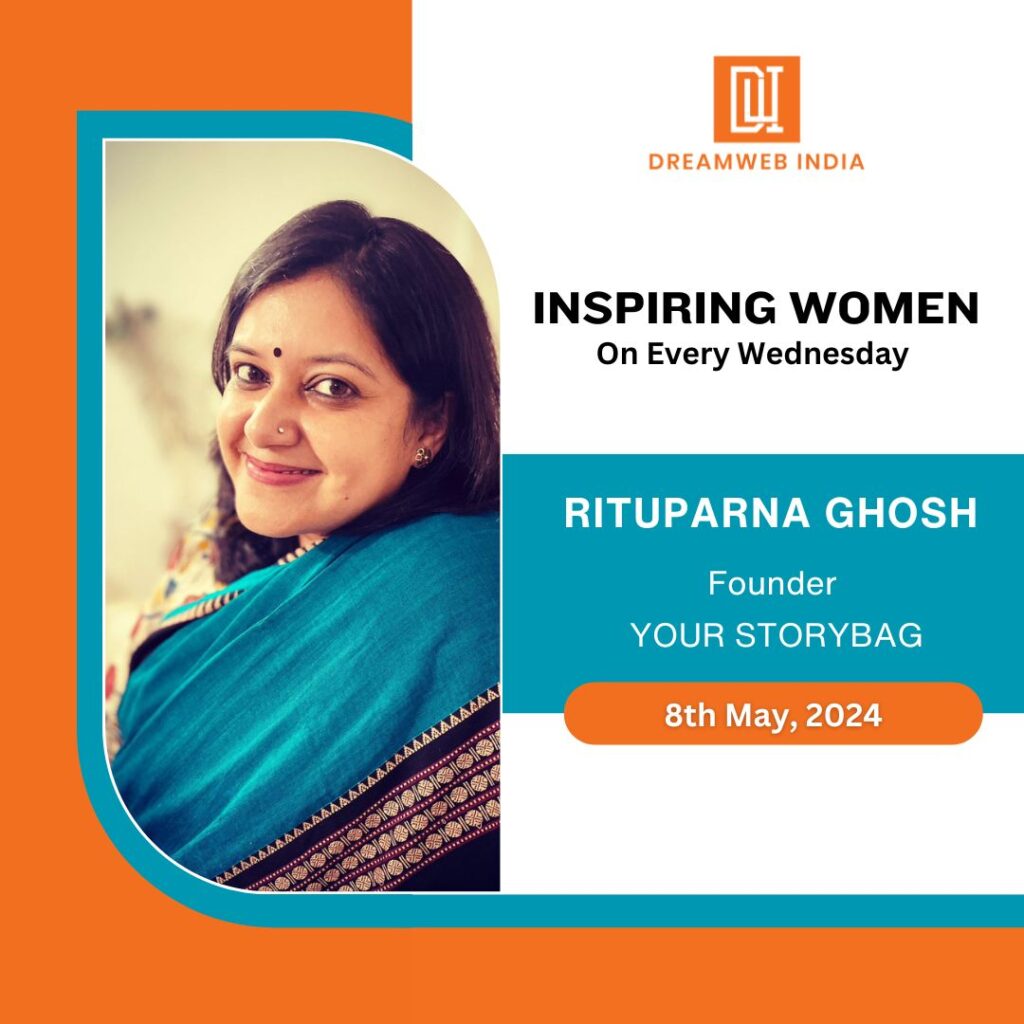
Inspiring Women Every Wednesday: Rituparna Ghosh
An International Storyteller and a TEDx Speaker Storytelling will be the strongest currency in the world Rituparna Ghosh For a span of five years, Rituparna shared her expertise in Storytelling and Children’s Literature at Delhi University. Additionally, she played a pivotal role in crafting the early years program for Delhi Government Schools, ingeniously integrating English, Hindi, and monthly themes through the medium of stories. More recently, Rituparna collaborated on the development of the Storytelling as Pedagogy Manual for CBSE. Through the platform of Your Story Bag, she has diligently conducted training sessions for numerous teachers and storytellers across India. Within the corporate and non-profit sectors, Rituparna has spearheaded projects that harness storytelling for diverse purposes, including Training, Company Branding, Change Management, Communication, Fundraising, Marketing, Program Facilitation, and Gender Sensitization. ‘Rituparna believes there is a storyteller in each of us. Children and adults need stories and storytelling skills all of their lives, to make sense of the world and give shape to their ideas.’ Let’s Get Inspired In Conversation with Rituparna Ghosh – Preeti Juneja Q. Stories breathe life into ideas. Which is your favorite marketing campaign? Marketing often intertwines with storytelling, especially during events like Women’s Day or Diwali, where brands invest significantly to evoke a feel-good factor. When it comes to marketing, I admire organizations and brands that prioritize storytelling as a sustained strategy. One such brand is the Whole Truth, a food brand that goes beyond selling protein bars and food items. The brand’s core mission is to enlighten consumers about the Whole Truth, to demystify food labels, and to reveal the nutritional content of every item they consume, thereby promoting healthy eating. I like it because this brand has held on to the raw thread of storytelling—the company’s branding activities, marketing, packaging, and communication in newsletters and social media are all based around storytelling. It is not a one-off campaign; it’s a brand strategy to ensure everything is around storytelling. And for me, that’s the whole idea behind a brand which does marketing, where marketing is not the end of selling a product. They’re also changing the narrative when trying to change how to consume food and the kind of misinformation out there. If you’re looking at storytelling as a way of sharing ideas, this brand is doing a particularly good job of it. Q. What is the story structure you follow to keep your audience focused and engaging? I’m fascinated by the question of story structure because there’s no one-size-fits-all formula. It varies depending on your audience – whether they’re children, adults, or individuals you’re encouraging to think critically or creatively. The structure and format you choose depend on the purpose behind your storytelling. So, rather than having a favorite structure, my approach adapts to the specific goals I aim to achieve with my audience. Q. Content inspiration is everywhere. a) Where do you get your source of inspiration for content creation? My ideas stem from various sources within me, triggered by questions, observations of mistakes, disagreements with others, or reflections on literature. When crafting content for storytelling, I prioritize audience input, allowing their preferences to shape how I present my ideas. For instance, when collaborating with a nonprofit, I focus on communicating their mission, drawing insights from how businesses and organizations engage their audiences to care about their cause or purpose. Cross-sector and cross-segment analyses of my clients and projects often inspire content dissemination. Even mundane experiences, like telling a multilingual story to children, spark ideas about language usage and audience engagement. I repurpose such experiences to cater to different audiences, understanding that the same incident can offer diverse perspectives. I thrive on the exchange of ideas and constantly seek inspiration from my work and experiences. Learning from children’s storytelling informs my approach with adults, adapting techniques to suit different contexts, such as teaching or corporate settings. Content creation, to me, encompasses storytelling methods, discussions on the art of storytelling, and tailoring storytelling as a tool to engage diverse audiences. It’s a fluid process, influenced by the audience and the desired outcome of our interaction. b) “Moment Marketing” is a double-edged sword. What are your views on it? a) I’m not a big fan of what is commonly referred to as ‘moment marketing ‘, a strategy where brands leverage current events or trends to promote their products or services. Amul is The only brand that does an excellent job of this. Unless you follow the Amul rule book of moment marketing and storytelling or the brand voice they exhibit during such times, no other brand does it anywhere close to what Amul does. On the contrary, brands tend to be insensitive and try to grab landlight or jump onto the trend. Social media has created this whole urge to make every story your own. It’s like that boring cousin of yours; no matter what is being told in the room, your cousin will jump in and say, oh, it happened to me also and this is what happened to me so you know that’s what ‘moment marketing’ is like so I’m not very fond of it and sometimes people you know do it very very poorly so that’s not what I like about ‘moment marketing ‘. Q. What are qualities of a good storyteller? Share few effective tips and tricks of compelling storytelling? STORYTELLING is really like a nuclear bomb in your hands. A skilled storyteller wields this power with awareness, sensitivity, and integrity, refraining from manipulation and embracing storytelling’s transformative potential. Each story has the potential to inspire, educate, and change lives, making storytelling a powerful tool in the hands of a skilled storyteller. Any storyteller must grasp that storytelling isn’t about self-absorption. Instead, it’s about considering the audience, the listeners, and the target demographic you’re addressing. Secondly, it involves recognizing the story as a medium to convey something meaningful. A proficient storyteller understands the supremacy of the audience and surrenders to their power, acknowledging that the narrative revolves solely around them. Without